How To Place Your Social Media Information Inside Google
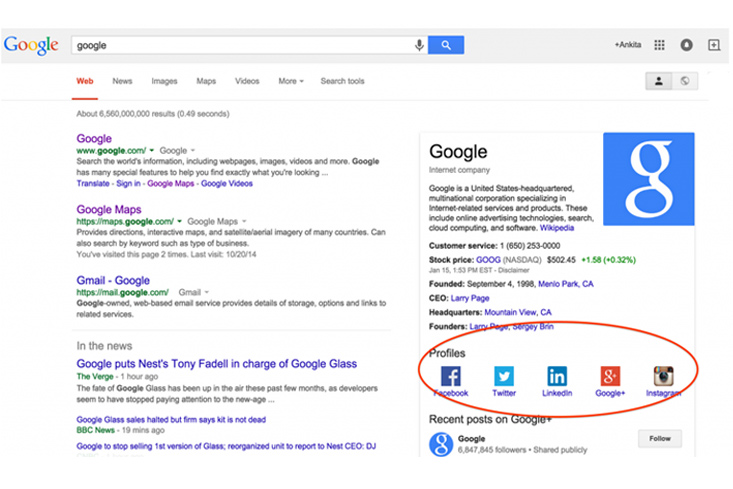
Have you ever wonder what will it want to get your social media info within Google? You know, that neat-looking set of social media icons that go slightly below your business info, permitting folks to directly navigate to your ‘social side’
Let’s face it – most people think that Google is great for showing online users results about businesses, services, products, and other general information. And the maximum amount as this is often utterly true, there’s one different facet of the story regarding Google.
The side which not only helps us see information but actually leads us to it.
And that is why Google is equally important for the success of businesses nowadays – and why they should do everything to get on Google. They are after all able to point potential customers to businesses and eventually help them become long-time, loyal customers of the brand.
But this is often just one of the various reasons why Google Maps is today essential to each business and its online success.
Now, if you thought that its’ easy to get on Google because the site automatically indexes every place out there and makes it virtually present on Google, you are wrong. Getting your social media information inside Google is a process – one which we are listing in steps today. So…
How To place Your Social Media info within Google (In three easy Steps)
If you would like to be told a way to get on Google exploitation your social media info solely, you’ll be able to try this in four easy steps – listed below.
Step 1: Create Your Line Of Code
(Called Structured Markup)
You may feel like a developer while doing this, and that’s totally cool. This is actually a process where you create your unique list of information that Google will be able to find when it comes to your website and uses it accordingly.
Here is that the line of code – you simply ought to replace the bolded links along with your social media profile links for each channel consequently.
{ “@context” : “http://schema.org”,
“@type”: “Organization”,
“name”: “Your Organization Name“,
“url”: “ http://www.your-site.com “,
“sameAs” : [ “ http://www.facebook.com/ your-profile “,
“ http://www.twitter.com/ yourProfile “,
“ http://plus.google.com/ your_profile “] }
Once you do this, you are halfway done with getting your social media information inside Google.
Step 2: Upload Your Structured Data
Now that you simply have replaced the code higher than along with your social media links, you need to add it to your website so that Google crawls it successfully. For most of us, that means the homepage.
The best way to put the code to your homepage is right before the closing </head> tag in the header section of your website. And in case you don’t know what this represents, just email this article to your webmaster and they will know what to do.
Step 3: Check Out If It Works
Once your code is added, it should work. But so as to create positive that it works, visit the Google Testing Tool, click on ‘Fetch URL’ and type in your website’s address. The tool will automatically copy the same structured data showing up in the testing tool – and light up green (with an ‘All good’ message and a tick) if the entire process is successful.
In case you did not succeed in the entire process, don’t stress.
The next time the robots crawl your web site, they’re going to with success place your social media info within Google – and you’ll simply get on Google with all of your social icons.
Speaking of social media….Have you ever wondered how your social media posts score when it comes to OpenGraph?
‘Open-what?’ – is probably what you are thinking right now…
Social Profiles Google Supports
Currently, Google only allows specific social networks to their knowledge panels. They encourage you to add others (like Pinterest!), but the profiles they support include:
- Google+ (shocking, I know)
- YouTube
- Myspace (Really, Google? MySpace…)
According to Google, the Google algorithm processes the social networks you have identified and shows the most relevant results.
How To Use Open Graph – And What’s It All About
The best way to explain what Open Graph is all about is to describe it as the standard that all social media posts should adhere to. Basically, learning how to use Open Graph will help you make most of all your posts – and make them appear better to your readers.
Basically, Open Graph simulates that box that automatically pops up below on Facebook, Twitter and any other social media network whenever you share a link. In order to learn how to use it.
Now…
Open Graph is a language that uses three different code lines:
- og:title – simulating the title of the post
- <meta property=”og:title” content=”Your eye-catching title here” />
- og:url – simulating the canonical URL for the page you are sharing
- <meta property=”og:url” content=”http://www.yourdomain.com” />
- og:type – simulating the kind of object you are sharing, whether it’s a blog post, video or a picture
- <meta property=”og:type” content=”website” />
Once you hit ‘Inspect Element’ in your browser and locate these codes, you will be able to edit the information in the boxes that automatically appear below the links you are sharing.
Who thought that is possible, right?
AS a Final Word
So today, we learned two valuable things. How to place your social media info within Google and the way to use Open Graph to alter what you post on your social networks.
We hope that obtaining your social media profiles listed on Google Maps can facilitate your business on a usual to boost your website’s complete awareness and visibility!
 SEO Expert Kerala- Aiswarya Thampi SEO Expert